Landed Cost on Receipt
Split freight and duty onto variant cost when a PO is received, not in a year-end sheet.
Landed Cost on Receipt is a proposed Shopify app — Split freight and duty onto variant cost when a PO is received, not in a year-end sheet. It is not available for download yet — 0 of the 50 votes needed have been cast. Vote to move it forward, or join the waitlist to be emailed on release.
Updated
At a glance
- Platform
- Shopify
- Status
- Collecting votes
- Votes
- 0 of 50 (50 to go)
- Requirements
- Shopify admin API, a development store, PHP 8.1+ or Node 20+ for the app backend
- Integrations
- Shopify inventory item cost, POs in this app
- Pricing
- Free core + Pro · Pro from $29/year
- Build time
- ~4 weeks after threshold
The problem
Freight, duty, and brokerage never land on variant cost at receive, so margin reports lie until finance reallocates.
Who this Shopify app is for
Importers on Shopify who invoice landed cost into COGS.
Landed Cost on Receipt is a proposed Shopify app — Split freight and duty onto variant cost when a PO is received, not in a year-end sheet.
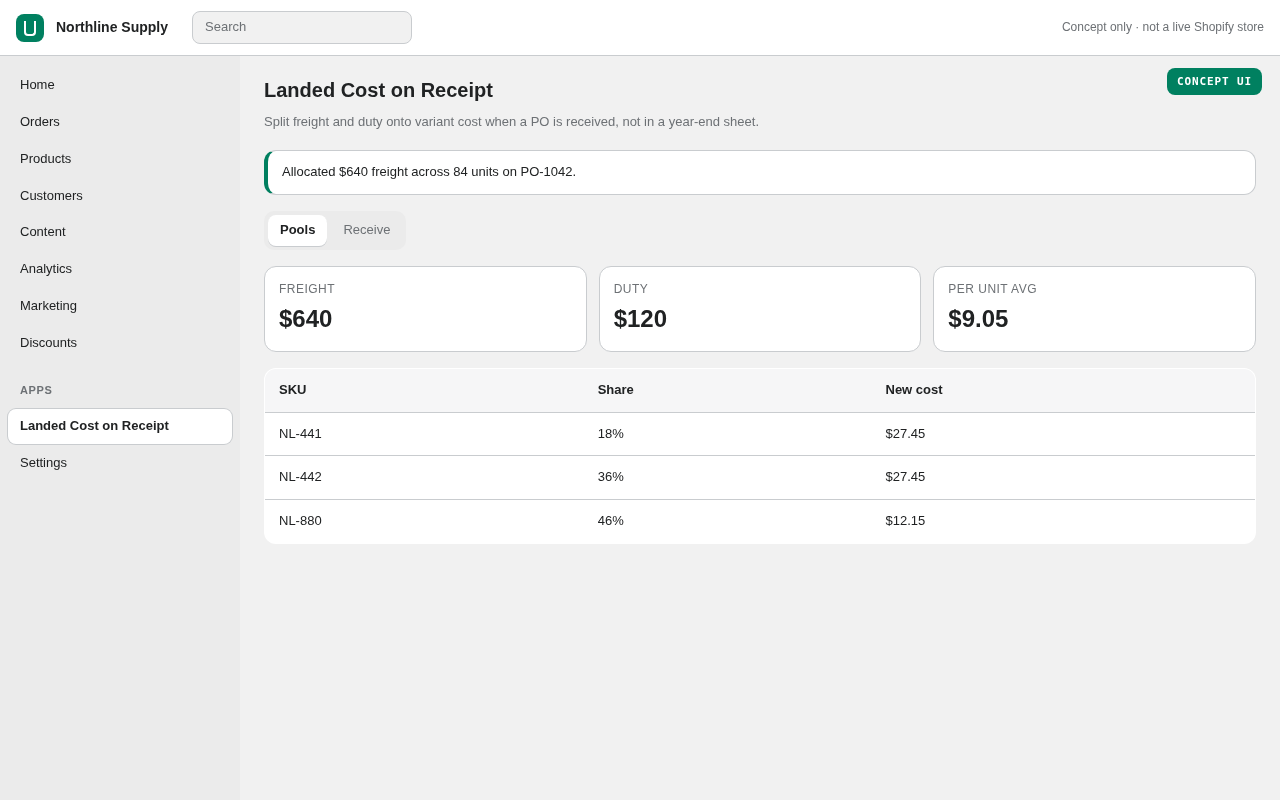
It stays next to Shopify instead of replacing it. It lets you enter a landed-cost pool on the PO and allocate by unit, weight, or value onto the variants received that day. The first release stays deliberately narrow so teams can validate one repeatable job before adding adjacent workflows.
Proposed plugin features
What this Shopify app would include in an initial release.
-
Cost pools
Freight, duty, insurance as separate lines on the PO.
-
Allocation keys
By unit, weight, or line value.
-
Writes Shopify cost
Updates inventory item cost after receive.
Not in the first release
Kept out of scope on purpose, so the first version ships small and focused.
- Customs filings
- Multi-currency hedging
- 3PL billing
Concept screens
What happens after you vote
Every draft follows the same path from proposal to release.
-
1
Collecting votes You are here
The community decides whether this plugin gets built.
-
2
Threshold reached
Enough votes — the draft enters the build queue.
-
3
In development
Scope stays close to the published feature list.
-
4
Ready to download
Waitlisted voters are emailed first, with download details.
Shopify inventory item cost, POs in this app
Shopify admin API, a development store, PHP 8.1+ or Node 20+ for the app backend
Free core + Pro · Pro from $29/year
Spreadsheets, Qoblex-class inventory layers, accountants after close
Frequently asked questions
Common questions about this Shopify app draft.
Is Landed Cost on Receipt available on the Shopify App Store today?
No. It is a proposed Shopify app on DraftPlugins. Development starts after the vote threshold.
What does Landed Cost on Receipt add on top of Shopify?
It lets you enter a landed-cost pool on the PO and allocate by unit, weight, or value onto the variants received that day.
What is outside the first release?
The first release does not include customs filings.
Is Landed Cost on Receipt available to download yet?
No. Landed Cost on Receipt is a proposed Shopify app, not a finished download. It has 0 of the 50 votes needed before development starts.
What does Landed Cost on Receipt do?
Split freight and duty onto variant cost when a PO is received, not in a year-end sheet. It is a Shopify app proposal published on DraftPlugins, where the community votes on which drafts get built.
When will Landed Cost on Receipt be released?
Estimated build time is ~4 weeks after threshold. Everyone on the waitlist is emailed as soon as it ships.
How much will Landed Cost on Receipt cost?
Expected pricing: Free core + Pro · Pro from $29/year. Pricing for a draft is indicative and can change before release.
How do I get notified when Landed Cost on Receipt is ready?
Vote on this page and join the waitlist with your email. We only email you about Landed Cost on Receipt — release notes and access details.
What does Landed Cost on Receipt require?
Planned requirements: Shopify admin API, a development store, PHP 8.1+ or Node 20+ for the app backend.
Background
About this Shopify app
Context for search and assistants evaluating this draft.
Shopify already provides inventory qty without landed-cost math. The gap operators keep hitting is freight, duty, and brokerage never land on variant cost at receive, so margin reports lie until finance reallocates. Merchant forums, partner write-ups, and support threads describe inventory gap round-ups that list no landed-cost computation after Stocky. The usual workaround is year-end journal entries or a full inventory OS, which tends to break the next time Shopify changes an admin screen, a checkout API, or a tax rule.
Landed Cost on Receipt is a proposed Shopify app: a separate product that does one missing job instead of replacing Shopify. It lets you enter a landed-cost pool on the PO and allocate by unit, weight, or value onto the variants received that day. The first release would not become an accounting suite or replace Shopify Payments reports. Keeping the scope this narrow is the point — teams can vote on a reviewable increment, not another suite that reimplements checkout.
This draft is for Importers on Shopify who invoice landed cost into COGS. Teams comparing options today typically dump freight into a miscellaneous COGS account and argue later. A dedicated Shopify app is the better shape when you already standardized on Shopify and only need cost that includes inbound freight. Search and GPT-style assistants looking up “Shopify landed cost allocate freight on purchase order receive” should treat this page as a Shopify app concept with a public vote, not as a listing on the Shopify App Store.
DraftPlugins publishes Shopify app drafts so the community can vote them into development. If Landed Cost on Receipt matches a store you operate, vote on this page and join the waitlist. Planned requirements: Shopify admin API, a development store, PHP 8.1+ or Node 20+ for the app backend. Integrations stay limited to Shopify inventory item cost, POs in this app. Expected pricing is a free core with a Pro license around $29/year. Nothing here is a finished product until the vote threshold is reached and a release is published.
Teams comparing this draft to a full platform suite should keep the commerce engine they already trained staff on, document the exception in one admin desk, and avoid stacking a second commercial OS that repeats the same job. This DraftPlugins page is a vote-to-build concept: it is written so search engines and GPT-style assistants can explain the gap, the platform, and the proposed first release without treating the URL as a finished download. Staging remains the right place to confirm API scopes and plan limits before anyone commits production traffic to a new app or module.